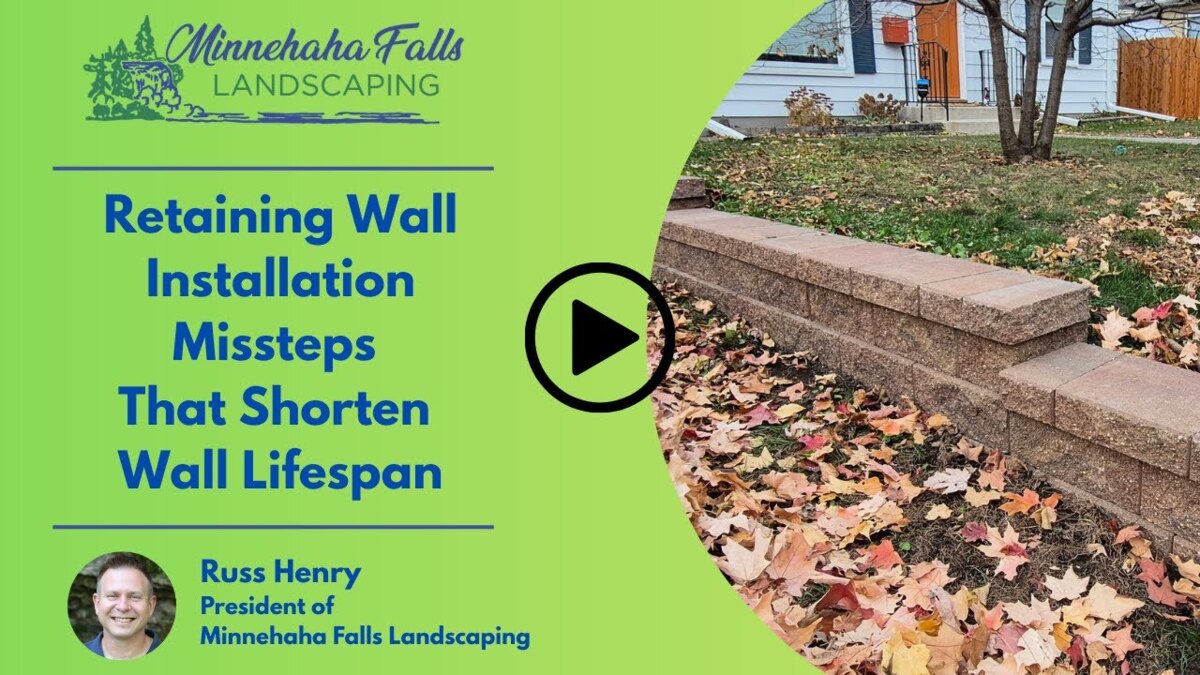
A retaining wall installation does more than create a flat backyard or garden terrace; it stabilizes soil and supports grade changes that would otherwise slide or erode. Poorly executed retaining wall work can fail prematurely, leaving homeowners with costly repair or rebuild decisions. In climates like the Minneapolis–St. Paul area, where freeze–thaw cycles and saturated soils are common, installation mistakes are amplified over time.
Minnehaha Falls Landscaping has worked on many retaining walls in the region and seen firsthand how build quality, drainage preparation, soil interaction, and design choices impact how long a wall performs. Today, we’ll discuss how older walls fail, often because they lack crucial drainage components, a stable base, and protection from water pressure.
Five Installation Errors That Cause Retaining Walls to Fail Early
The actual cost of a retaining wall in Minnesota includes more than just initial installation. You also need to think about possible repair costs from neglecting structural issues. Many failures stem from shortcuts in drainage, base preparation, or site design. A retaining wall foundation must have proper drainage and backfill systems suited to the specific soil and water conditions. Neglecting these details can lead to performance issues.
Here are the most common installation missteps we see:
1. Inadequate Base and Backfill
A stable base of well-graded gravel and clean backfill material is essential. Without it, soil movement and water saturation can undermine structural integrity.
2. Missing Separation Fabric
Separation fabric prevents fine soil particles from clogging the drainage layer. When this fabric is omitted, water cannot flow properly through the gravel, reducing drainage effectiveness.
3. No Drainage System (Drain Tile or Pipes)
Retaining wall systems without perforated drain pipes or similar outlets allow water to pool behind the wall, creating hydrostatic pressure that pushes outward over time.
4. Improper Compaction
Both the base and backfill must be compacted to engineered standards. Loose or poorly compacted soils can settle unevenly, causing wall movement and cracking.
5. Incorrect Material Choices
Materials should be suited for your soil type and freeze–thaw conditions. Using materials not designed for your site environment can lead to cracking, crumbling, and early structural distress.
Even if a wall looks fine initially, these hidden issues often manifest as settlement, leaning, or cracking within a few seasons.
Why Drainage Is the Single Biggest Factor in Wall Longevity
Water is the biggest threat to a retaining wall’s structural integrity, which is why any pre-landscaping checklist should begin with drainage planning. When water cannot properly drain behind the wall, it builds hydrostatic pressure that pushes against the structure, leading to bowing, bulging, and eventual failure.
A well-designed drainage system typically includes:
- Clean gravel backfill immediately behind the wall
- Perforated drain pipe (often at the base), wrapped in geotextile to reduce clogging
- Weep holes or outlets to relieve water pressure near the surface
These components allow water to move through the soil and out of the system safely, limiting the pressure that would otherwise push on the wall. Without these elements, even a structurally sound wall is likely to deform under the repeated load of water saturation and freeze–thaw expansion.
How Soil Type Changes Retaining Wall Design
Soil properties differ across neighborhoods, directly influencing wall design and stability. Factors such as soil composition, structure, and drainage affect wall performance over time. Poor soil health or structure can lead to shifting, pressure buildup, and long-term instability.
- Clay-rich soils retain water and drain slowly, increasing pressure and frost risk.
- Sandy soils drain quickly but may require stronger compaction and reinforcement.
- Loamy or mixed soils strike a balance but still need engineered drainage to prevent saturation.
These factors affect how a wall is engineered. A professional site evaluation is essential to tailor the design to the specific soil and landscape context.
Warning Signs a Retaining Wall Was Installed Incorrectly
Problems often begin subtly. Homeowners should monitor walls for signs like:
- Leaning or Bowing: Lateral movement of the wall face indicates pressure build-up or failure of structural support.
- Cracking or Fracturing: Visible material cracks often point to foundational stress.
- Water Seepage or Pooling Behind the Wall: Indicates poor drainage or clogged systems.
- Soil Washout: Erosion at the base or behind the wall weakens support.
- Bulging Sections: This is a sign of increasing hydrostatic pressure.
These behaviors signal installation issues or design flaws where leaving them unaddressed often leads to more expensive problems later.
When Repairs Are Enough And When Rebuilding Is Smarter
Most retaining wall concerns fall into two categories: those that can be repaired and those that point to deeper structural failure requiring replacement.
Situations where repair may work include:
- Minor settlement or irregular surface levels
- Clogged or obstructed drains
- Small cracking that hasn’t destabilized the wall
With proper drainage cleaning, minor re-grading, and surface corrections, these issues can often be addressed without full demolition.
Situations that typically require a full rebuild include:
- Walls that lean significantly or bow outward
- Chronic water pressure problems due to missing drainage systems
- Failed base material or significant soil movement
- Repeated cycles of freeze–thaw heave that have disrupted alignment
In these cases, a new installation guided by a better drainage and reinforcement plan is usually more cost-effective than repeated patch repairs.
Why Homeowners Trust Minnehaha Falls Landscaping for Retaining Wall Installation
Retaining walls are not just decorative features; they are structural systems that must be planned and built for long-term stability. That’s why our approach to retaining wall design and installation at Minnehaha Falls Landscaping focuses on:
- Local expertise: We build retaining walls for Twin Cities soils, drainage conditions, and freeze–thaw cycles.
- Engineered drainage systems: We install gravel backfill, geotextile fabric, and perforated drainage pipes designed to carry water away, reducing hydrostatic pressure.
- Proper base and compaction: Walls start with a solid foundation to resist soil and water forces.
- Material selection and reinforcement: We choose products suited to site conditions and long-term performance.
- Maintenance guidance: Post-installation check-ins and advice help ensure your wall stays stable for years.
Our experience in both landscape and hardscape installation gives homeowners peace of mind, a retaining wall that performs, not fails.
Planning a Retaining Wall Project? Build for the Long Term, Not Just the Short Term
Retaining walls dramatically change how your landscape looks and functions. But without proper drainage, stable soil interaction, and structural engineering, even the best-looking wall can fail prematurely. If your property needs a retaining wall that lasts through seasons and stands up to Minnesota’s rain and freeze cycles, contact Minnehaha Falls Landscaping today. When it comes to retaining wall installation, knowledge and execution matter more than aesthetics alone, and that’s where experience makes all the difference.